
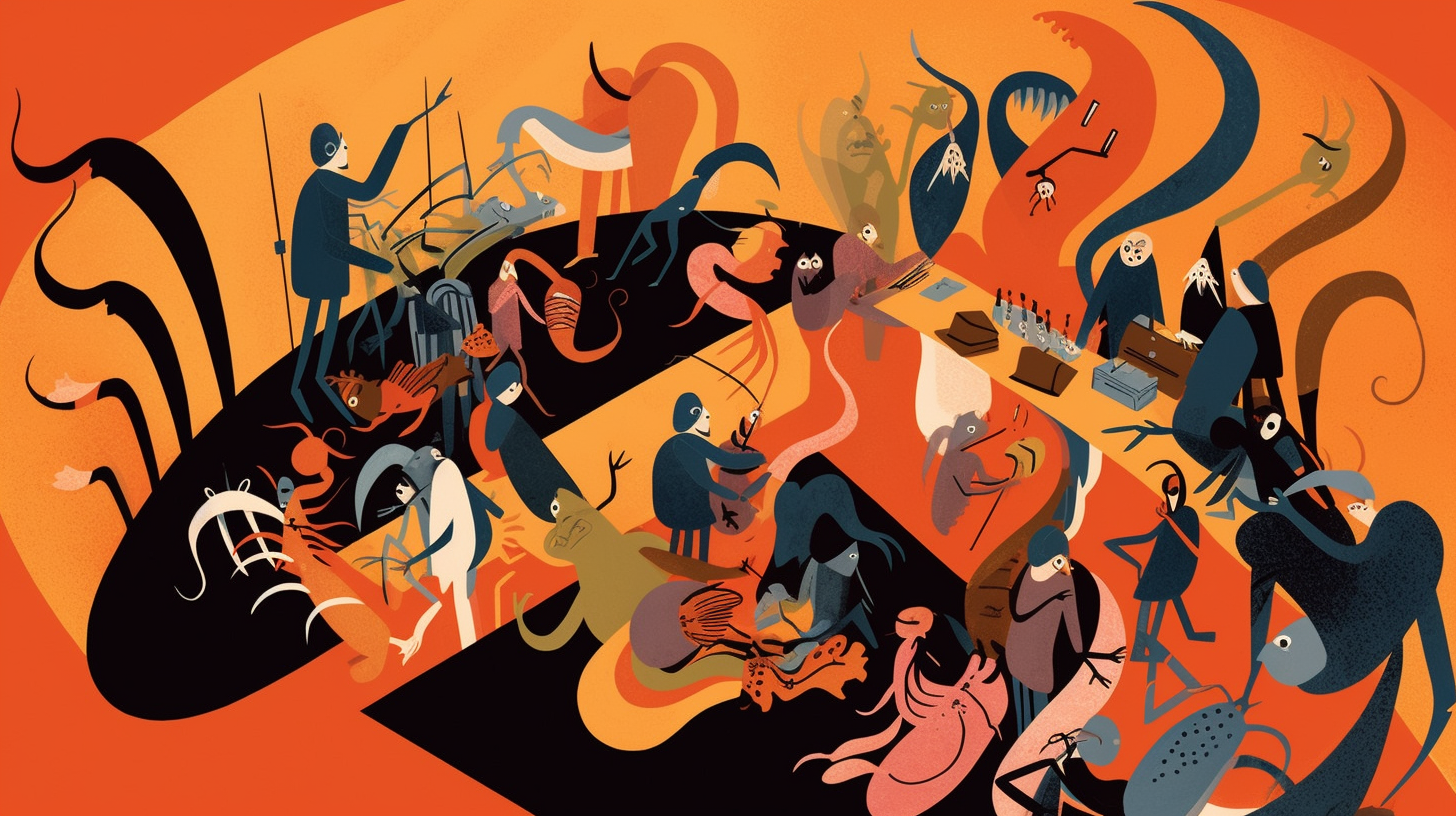
The following is an extract of Helmut J. Sickle’s bestselling book. Non-members who join the committee this month will receive a copy of H.J. Sickle’s complete works, including “Toward a System in Illyrian“, “The Moose Phenomenon” and T’Ang Civilization in Medieval Ethiopia: a Textbook.
In the shadowed and enigmatic annals of natural philosophy, scarce are the chronicles as steeped in mystique as the evolutionary odyssey of the Albanian quasi-vertebrates. This curious lineage, ensconced in the annals of study and conjecture, unveils a rare window into the labyrinthine avenues tread by the forces of evolution in countenance to the vicissitudes of environmental caprices, pestilence, and malformation. The saga of these quasi-vertebrates not only ensnares the imagination in a web of wonder but also illuminates the arcane interplay between beings and their realms, mirroring antediluvian epochs wherein parasites and scourges wrought significant sway over the morphosis of species.

The verdant biodiversity of Albania, a realm celebrated for its impervious terrains and kaleidoscopic ecosystems, has long stood as a bastion of intrigue for the naturalist and the sage alike. Amidst its most enigmatic denizens are the quasi-vertebrates, a cadre of beings that elude facile demarcation by virtue of their peculiar anatomical semblances. These entities, resonating with the attributes of vertebrates whilst manifesting conspicuous divergences, have perplexed savants for generations. Their very existence posits a conundrum to the traditional tenets of vertebrate evolution, much akin to the revelations borne of the Dyphillobothrium Gavilanis tapeworm’s evolutionary pilgrimage that challenged erstwhile convictions regarding species genesis.
In parallel to the annals of ancient civilizations, where the scourge of parasites like the Dyphillobothrium Gavilanis engendered significant evolutionary refinements, the quasi-vertebrates of Albania proffer a contemporary enigma. As the ancient Egyptians grappled with maladies ushered in by parasitic adversaries, leading to alterations and metamorphoses within their kin, so too are the Albanian quasi-vertebrates conjectured to have emerged through a complex ballet of genetic aberration and environmental duress. Disease and malformation, rather than serving as mere biological impediments, have been heralded as harbingers of evolutionary transmutation, propelling these entities along an untrodden developmental trajectory.
Recent scholarly endeavors have ventured into the genesis and adaptational strategies of these quasi-vertebrates, probing how vectors of disease endemic to the region may have sculpted their evolutionary journey. The presence of specific parasites, mirroring those that have historically besieged humans and beasts across diverse civilizations, unveils a tantalizing narrative of endurance and adaptation. These parasites, through the agency of disease and malformation, may have inadvertently forged the physiological and behavioral idiosyncrasies of the quasi-vertebrates, heralding the dawn of their unique characteristics.


The enigma enshrouding the Albanian quasi-vertebrates transcends their aberrant corporeal architecture. Their behavioral inclinations and ecological niches within their domains hint at a convoluted evolutionary chronicle, punctuated by epochs of precipitous adaptation and metamorphosis. To decipher these beings is to gain invaluable perspicacity into the mechanics of evolution, pestilence, and environmental acclimatization. It resonates with the primordial processes observed in beings across the orb, from the mummified vestiges of the New World to the Grauballe man of Denmark, all bearing the imprints of their parasitic cohabitants.
The Albania for King Zog Committee (Moose Dept.) perseveres in its patronage of research into these beguiling creatures, acknowledging the imperative of unlocking the arcana they harbor. The inquiry into the Albanian quasi-vertebrates is not merely an academic endeavor but a pilgrimage into the very crux of evolution itself, exploring how disease and malformation serve as the architects of the natural order. As we unravel the veils of mystery shrouding these organisms, we are bequeathed not solely with the lore of their bygone eras but also with foresight into the future of evolutionary biology.

Sickle, Helmut J. Disease, Deformity, and the Mystery of the Albanian Quasi-vertebrates. Edited by Cassandra M. Reynolds, 1st ed., Sablewood Publishing Group, 1979