
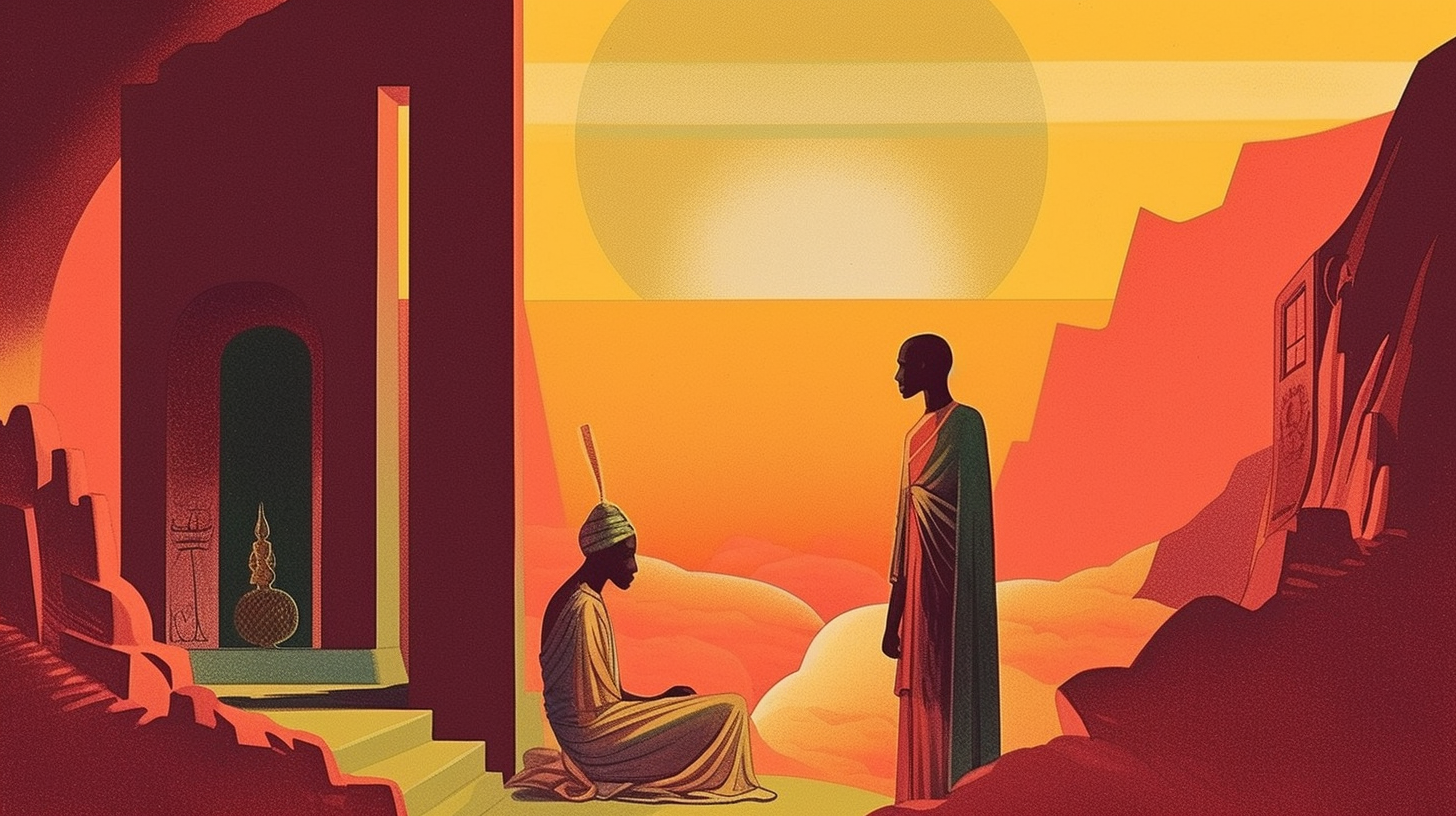
In the veiled annals of history, the T’Ang Civilization of Medieval Ethiopia emerges as a beacon of hermetic wisdom, linguistic unity, and ethnological complexity. This civilization, shrouded in the mists of time, offers a tantalizing glimpse into the confluence of esoteric traditions, the pursuit of a ur-language—a primal tongue believed to hold the key to the universe’s secrets—and the intricate tapestry of cultural identities that flourished in the heart of Ethiopia. “T’Ang Civilization in Medieval Ethiopia: a Textbook,” meticulously compiled by the esteemed scholar Helmut J. Sickle, delves into the depths of this enigmatic society, unraveling its mysteries and contributions to the fields of hermeticism, linguistics, and ethnology.
At the core of the T’Ang Civilization’s spiritual practice was hermeticism, an ancient philosophical and religious tradition that emphasizes the pursuit of Gnosis: direct knowledge of the divine. This tradition, deeply woven into the fabric of T’Ang society, influenced not only their religious rites and esoteric teachings but also their governance and social structure. Sickle’s analysis reveals how the T’Ang people believed in the harmonious interconnection of the macrocosm and microcosm, seeing themselves and their civilization as a microcosmic reflection of the universe’s vast, intricate design.


Central to the T’Ang Civilization’s quest for universal understanding was their pursuit of an ur-language. This primal language, as Sickle elucidates, was not merely a tool for communication but a sacred key capable of unlocking the secrets of the cosmos. The T’Ang scholars and mystics devoted lifetimes to deciphering this language, which they believed was once spoken universally before the diversification of tongues. Their work laid the foundations for what would later be recognized as comparative linguistics, but with a deeply spiritual aim: to reunite humanity with the divine through the power of primordial speech.
Sickle’s exploration of the T’Ang Civilization’s ethnological landscape unveils a society rich in diversity yet united under the banner of spiritual and linguistic quest. The T’Ang people, comprising various ethnic groups and tribes, exemplified a model of cultural synthesis and tolerance. This ethnological melting pot was bound by a shared commitment to the principles of hermeticism and the search for the ur-language, fostering a unique societal cohesion that transcended ethnic divisions.
“T’Ang Civilization in Medieval Ethiopia: a Textbook” is more than a historical treatise; it is a journey into the heart of a civilization that envisioned a world bound by spiritual unity and linguistic harmony. Through Sickle’s meticulous research and engaging prose, readers are invited to explore the T’Ang Civilization’s sacred rituals, philosophical teachings, and the enduring quest for a language that speaks to the soul of the universe.
Pennington, through his groundbreaking work, challenges contemporary scholars and seekers alike to reconsider the power of ancient wisdom and the potential of language as a bridge between the human and the divine. The T’Ang Civilization, though lost to the sands of time, serves as a luminous example of what humanity can achieve when it aligns its diverse cultural expressions with a shared, profound pursuit of knowledge and understanding.
In the hands of readers, “T’Ang Civilization in Medieval Ethiopia: a Textbook” becomes not just a source of academic enlightenment but a beacon of inspiration, urging us towards a deeper, more unified understanding of our place in the tapestry of human history.

Sickle, Helmut J. T’Ang Civilization in Medieval Ethiopia: a Textbook. 1st ed., Thistle & Thorn Publications, 1984.